Mysore (officially Mysuru) is the cultural capital of Karnataka. It is a city that moves to the slow aroma of incense, jasmine, and sandalwood, famously known as the home of Mysore-style Ashtanga Yoga. To travel here mindfully is to step back from the hyper-speed of modern India and engage with a legacy of royal architecture, sensory delights, and deep bodily awareness.
This guide explores the physical and spiritual layout of Mysore, detailing how to navigate its heritage sites, markets, and spiritual centers while practicing deep somatic grounding along the way.
---
Key Cultural Guide & Frequently Asked Questions
For travelers arriving in Mysore seeking to balance sight-seeing with mindfulness, here is a quick reference table outlining essential travel parameters:
| Question | Direct Answer | Recommended Practice |
| :--- | :--- | :--- |
| **Why is Mysore a global hub for yoga?** | It is the birthplace of Ashtanga Vinyasa Yoga, popularized globally by K. Pattabhi Jois. | Practice at a registered shala in Gokulam; observe local chanting rules. |
| **What is the best way to tour the heritage zones?** | Bicycling or walking through the residential streets of Lakshmipuram and Gokulam. | Take a guided heritage walk focusing on Indo-Saracenic design. |
| **What is the significance of Chamundi Hill?** | It is a sacred hill offering panoramic views of the city and hosting the Chamundeshwari Temple. | Climb the 1,008 stone steps silently at dawn to ground your senses. |
| **How do I manage travel fatigue in Mysore?** | Establish physical anchors and practice [Somatic Resourcing](/essays/mindfulness/somatic-resourcing) to regulate your system. | Rest in green spaces like Karanji Lake or the quiet lanes of Gokulam. |
---
The Landscape of Gokulam: Mysore's Yoga Heartland
Gokulam is a quiet, tree-lined residential neighborhood located in the northern part of Mysore. For decades, it has served as the quiet core of the international yoga community. Walking through its streets in the early morning dampness—around 4:30 AM or 5:00 AM—you hear the low, resonant vibrations of Sanskrit chanting filtering through window screens, accompanied by the scent of fresh jasmine and burning camphor.
The Ashtanga Tradition
Ashtanga Vinyasa Yoga is a highly structured, dynamic form of yoga that synchronizes breath with a progressive series of postures. In Mysore, this is traditionally taught in the "Mysore style" format, where students practice the sequence independently at their own pace while the teacher provides hands-on adjustments.
Practicing yoga in this format demands a high degree of internal focus. Because you are not following a teacher's spoken instructions in a group, you must turn your attention entirely inward, tracking your breath and heart rate. This physical intensity can trigger tight muscles, particularly in the lower back and hips, making restorative routines like the [Yin Yoga Hips Sequence](/essays/mindfulness/yin-yoga-hips) an essential evening practice to release travel stiffness and post-practice tension.
---
Majestic Horizons: The Architecture of Mysore Palace
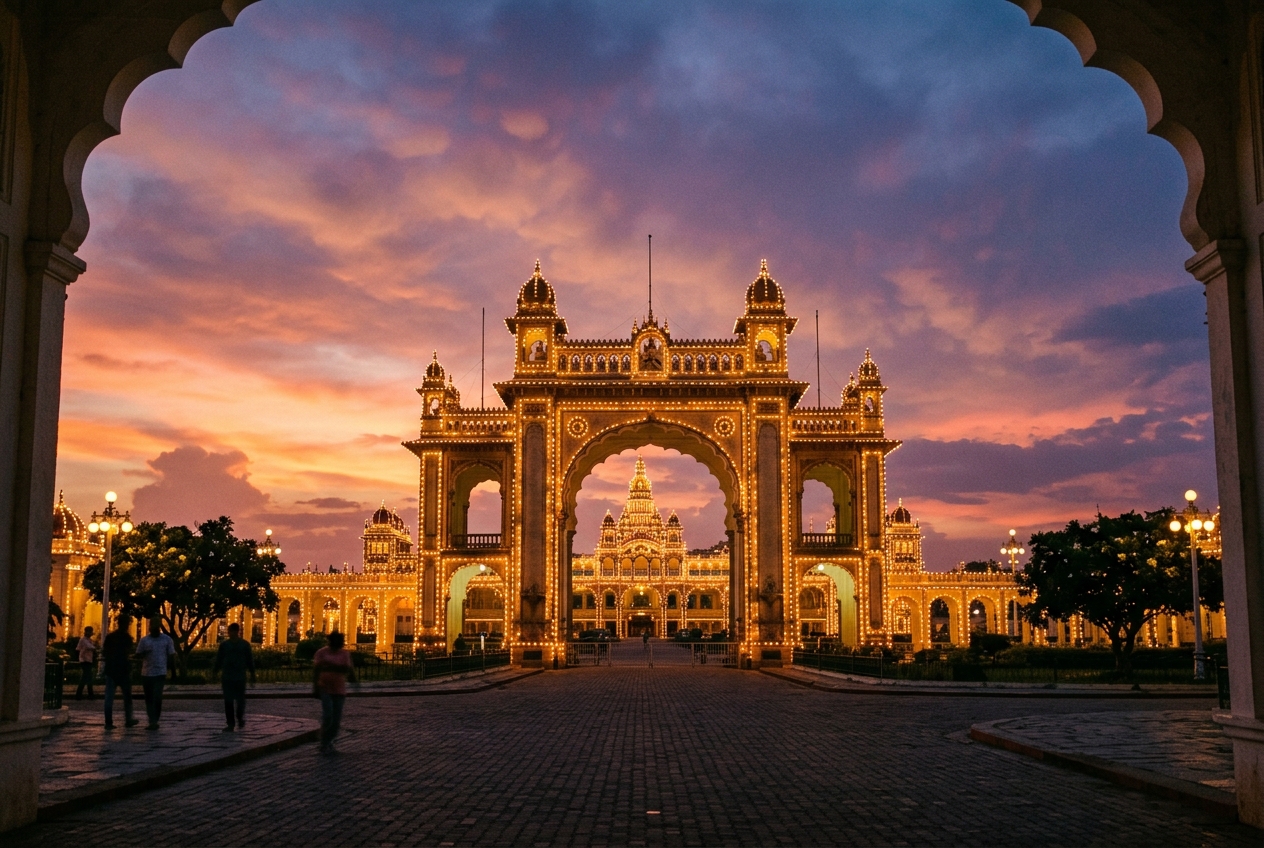
The crowning jewel of Mysore’s physical heritage is the Amba Vilas Palace, commonly known as Mysore Palace. Designed by the British architect Henry Irwin and completed in 1912, the palace is a masterpiece of the Indo-Saracenic style—a lavish blend of Hindu, Muslim, Rajput, and Gothic architectural elements.
A Sensory Walk Through the Palace
When you enter the palace gates, pay close attention to the scale of the structures. The massive domes, intricate arches, and carved columns are designed to evoke awe. For the mindful traveler, this is an opportunity to practice spatial awareness:
* **The Durbar Hall**: Walk slowly across the polished red-and-yellow tiled floor. Notice the high ceilings painted with floral gold leaf patterns. Observe how the light enters through the stained-glass windows, coloring the stone columns.
* **The Royal Pavilion**: Sit quietly near the central courtyard. Close your eyes for a moment and listen to the echo of voices bouncing off the stone walls. Feel the cool drafts flowing through the open corridors.
* **Sunday Illumination**: On Sundays and public holidays, from 7:00 PM to 8:00 PM, the entire palace facade is illuminated by exactly 97,000 light bulbs. Rather than rushing to capture this on your phone, sit on the lawn, watch the lights spark to life, and feel the collective gasp of the crowd.
---
Sensory Grounding in the Devaraja Market
Dating back to the reign of Tipu Sultan, Devaraja Market is a vibrant, chaotic, and historic bazaar located in the center of Mysore. For a traveler, it is a sensory overload. The narrow aisles are packed with vendors selling fresh fruits, bright marigold garlands, hand-rolled incense, and local perfumes.
To navigate this space without feeling overwhelmed, you must use your senses as anchors. When the noise of bargaining and the crowd becomes intense, pause, feel your feet firmly planted on the stone floor, and practice simple grounding:
1. **Sight**: Focus on a single color heap—the bright red kumkum powder or the yellow turmeric cones. Look at the geometry of the piles.
2. **Smell**: Walk past the sandalwood and jasmine stalls. Notice how the rich, woody scent of sandalwood grounds the sharp, sweet notes of jasmine. Sandalwood has been scientifically proven to lower heart rates and calm the nervous system.
3. **Touch**: Feel the texture of raw cardamom pods or dried ginger roots at the spice stalls. Engaging your hands with natural textures immediately pulls your focus away from anxious thoughts.
---
Climbing Chamundi Hill: A Dawn Walking Meditation
Located about 13 kilometers from the city center, Chamundi Hill rises 1,000 meters above the Deccan Plateau. For centuries, pilgrims have climbed the hill to pay respects to the goddess Chamundeshwari at the hilltop temple.
For the mindful wanderer, climbing Chamundi Hill is not a workout; it is a sacred walking meditation. The path consists of 1,008 stone steps carved out of the hillside in the 17th century.
```text
Step 1 - 200: Physical Awakening. Feel the muscles in your calves stretch. Focus on a steady, even breath.
Step 201 - 500: Rhythmic Flow. Coordinate your breath with your steps: inhale for two steps, exhale for two steps.
Step 500 (The Nandi Temple): Rest and Grounding. Sit beside the massive 5-meter monolith of Nandi, the sacred bull.
Step 501 - 1008: Silent Contemplation. Walk the remaining steps in total silence, observing the panoramic sky.
```
By the time you reach the summit, the physical exertion combined with the rhythmic breathing will have shifted your brain waves into an alpha state—characterized by relaxed alertness. Look out over the city of Mysore below as the sun climbs, appreciating the boundary between urban landscape and natural horizon.
---
Concluding Reflections on Mysore
Mysore teaches us that heritage is not static; it is lived. Whether you are holding a pose in a Gokulam shala, walking the tiled floors of the palace, or climbing the ancient stone steps of Chamundi, the city invites you to decelerate. By aligning your physical movement with the historic pace of this royal city, you cultivate an internal sanctuary that you can carry with you long after you leave its sandalwood-scented borders.