Long-haul travel—especially flights across time zones—imposes severe physical stress on the human body. Sitting for hours in narrow seats locks the hip flexors, compresses the lumbar spine, and keeps the nervous system in a state of high alert. For digital nomads and long-distance travelers, this physical compression often leads to “transit burnout.”
To decompress your nervous system and release muscle tension, there is no tool more effective than the Constructive Rest Pose (CRP). You can combine this passive posture with Vata-Pacifying Breathwork to accelerate your nervous system decompression, which is especially useful during high-frequency transits or cosmic shifts like the 888 Lion’s Gate Portal. For deeper physical alignment studies, refer to the somatic integration resources at the Dr. Ida Rolf Institute.
🦿 1. The Anatomy of the Psoas and Transit Compression
The psoas major is the primary muscle connecting your upper body to your lower body, running from your lumbar spine to your inner thighs. It is directly wired to your sympathetic nervous system’s fight-or-flight response. When you are startled or stressed (such as during airport security sweeps or turbulent flights), the psoas reflexively contracts, pulling your thighs toward your pelvis. Maintaining awareness of these stress holds is covered in our Goa Solo Female Safety Guide. You can also look up anatomy details on the Yoga Journal Pose Finder.
Sitting for 12 hours forces the psoas into a chronic state of contraction. If you do not release it upon arrival, this tension pulls on your lower back, causing backaches, shallow breathing, and persistent physical anxiety.
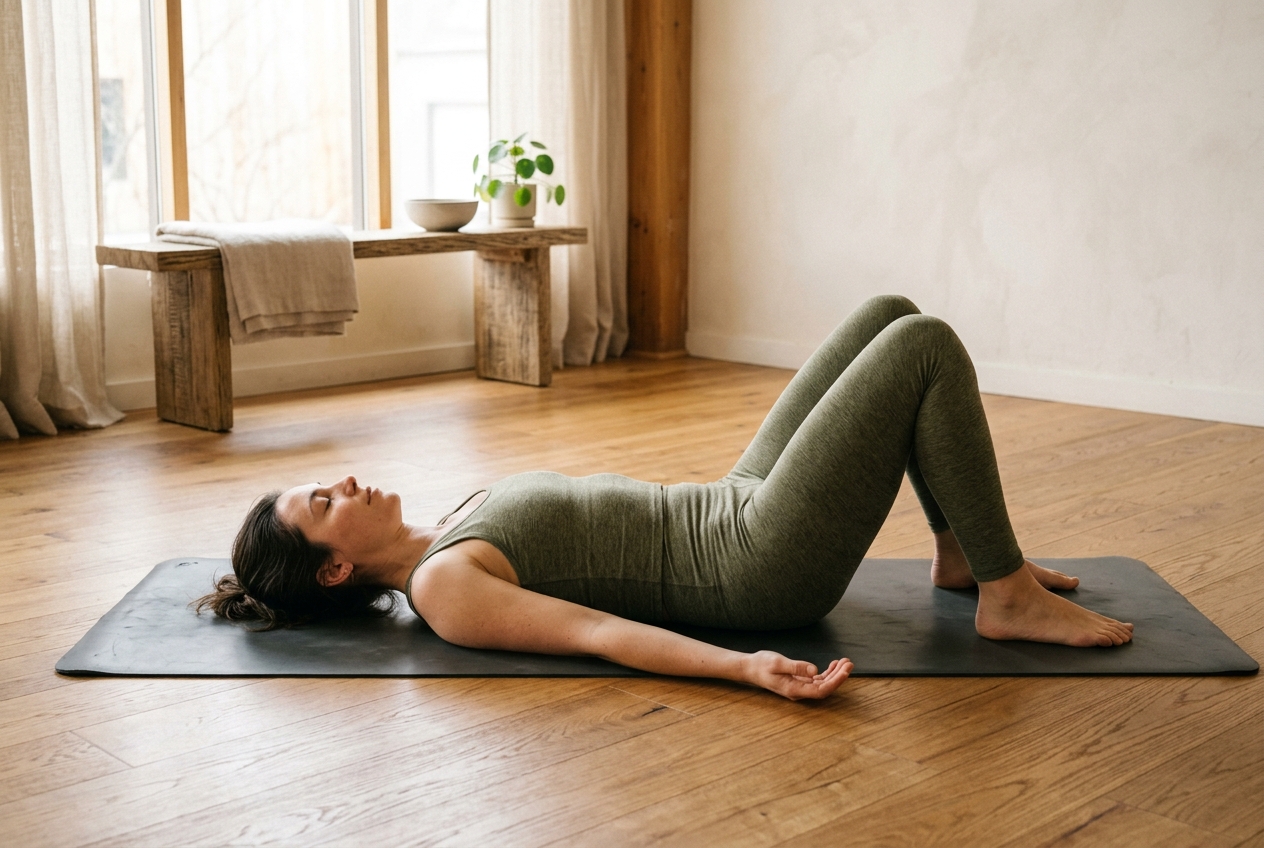
🧘 2. Constructive Rest Pose: Step-by-Step Instructions
This simple 15-minute somatic exercise requires no effort, allowing your psoas to release through gravity and yielding:
- The Setup: Lay flat on your back on a clean floor, yoga mat, or firm mattress.
- Knee Position: Bend your knees and place your feet flat on the floor, about hip-width apart.
- Foot Alignment: Position your heels approximately 12 to 16 inches away from your buttocks. Let your knees rest inward against each other, forming a stable tripod. This passive alignment allows your hip muscles to relax completely.
- Arm Position: Rest your hands gently on your lower abdomen to feel your breath, or let them lie open at your sides, palms facing up.
- Yielding: Close your eyes. Spend 15 minutes allowing the weight of your pelvis, rib cage, and head to sink into the floor. Do not try to flatten your back or stretch; let gravity decompress your spine naturally.
🌊 3. Somatic Benefits of Yielding After Travel
Somatic yielding into gravity recalibrates your system in several key ways:
- Psoas Release: Allowing the thigh bones to settle into the hip sockets signals the nervous system that it is safe to turn off defensive posture holds.
- Spinal Decompression: Grounding your spine without active effort lets the vertebrae return to their natural curves, easing pressure on compressed discs.
- Nervous System Reset: Resting quietly triggers the parasympathetic nervous system, helping to regulate digestive organs and ease transit anxiety.
📚 References
- Somatic Pioneer: Rolf, Ida P. (1989). Rolfing: Reestablishing the Natural Alignment and Structural Integration of the Human Body. Healing Arts Press.
- Psoas Expert: Staugaard-Jones, Jo Ann (2012). The Vital Psoas Muscle. Lotus Publishing.
- Somatic Context: Nervous System Reset: A 7-Day Somatic Travel Guide & Workbook by Akhi (2026).